
The Model S of Boats
Infinite Range at 15 MPH, Silent Gliding Elegance at 6
Sailboats have mythical status as the first choice of a lottery winner to sail off into the sunset because it is a grand act but also because that millionaire has nowhere else to be. Getting places is what humans love to do – or being places, not necessarily getting there. On a sailboat with a top speed of 7 or 8 mph you’re not getting anywhere fast so you have to tell yourself the journey is the point not the destination. But what if the destination really is the objective?
Speed through water is best achieved with a Hydrofoil. Rising up above the waves so the boat runs smoothly not only allows for speed, it massively reduces the effort of pushing a boat through the water. That increase in efficiency means you can use electric motors – silent, but even better than that, they could recharge from solar panels on the roof and/or a plug in the boathouse. Just like an Electric Vehicle.
Some effort has already been put into creating an electric hydrofoil. Candella makes a sleek, retro looking electric lake boat that is silent, maintenance-free and simply charges with shore power in its boathouse. But that is not a yacht you can sleep on. And it is built for speed not range.

Infinite Range?
What if you could have a comfortable weekend boat that moves through the water on just the energy pulled from the sun? Your range would be infinite.
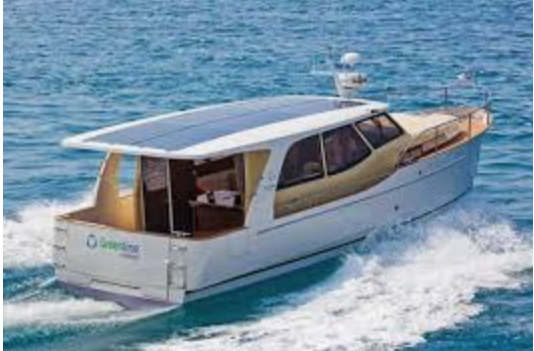
A boat called the Greenline can move through the water at 5-6 knots (about 7mph / 11kph) on its electric motor using solely the power gathered from the solar panels on its roof. It has both a diesel main engine and the electric motor,but it can go forever on just the electric motor as long as the sun shines. And it does so in full yachting luxury.
https://images.app.goo.gl/s7oeomA1Cki4nHHE8
The Greenline is a great idea but the real prize is somewhere in between it and the Candella. Imagine a boat that can maintain a speed more like 12 knots (24kph) using only the power gathered from the solar panels – not setting any speed records but enough to reach a destination without draining the onboard battery. At that speed, you could truly cover distance over water but in order to achieve this the boat must be up on a hydrofoil.
A long list of technical issues combat the practicality of running a hydrofoil boat at that speed over long distances, especially one driven by electric propulsion. The key is to have enough solar panel area and a large enough battery pack to store energy while underway or at anchor so your range exceeds your trip. Once the boat is up on its hydrofoil wings the energy required to keep it there is minimal. And with such a reduction in friction the result is a smooth, quiet, electric foil boat that rides above the choppy waves in an elegant, effortless glide. With electric motors the mechanical maintenance is dramatically reduced (because it has substantially fewer moving parts than any gas or diesel motor) and infinite range at a low but still practical speed.
The ultimate design of this boat will be one with a layout inside like any other 33 foot motor yacht or sailboat, including a stateroom or V-Berth up front and other bunks aft to comfortably sleep 4 adults or a slightly larger family with kids. It would also have a galley and shower/toilet as well as a table to eat at just as one would find on any yacht.
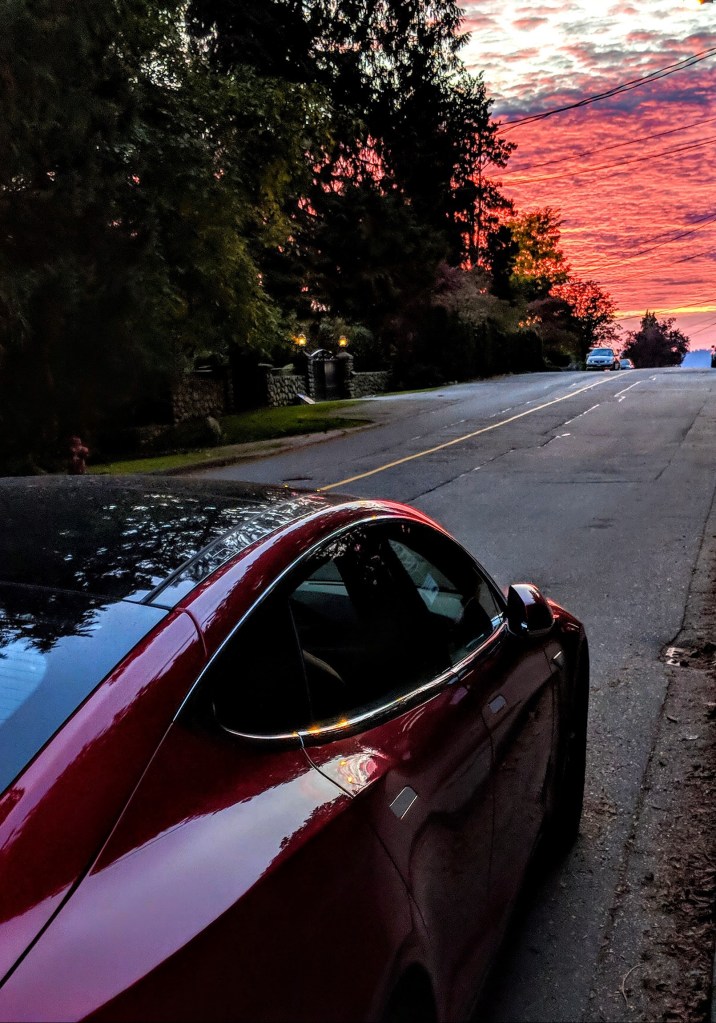
In many ways this will be the Tesla Model S of weekend yachts.
Folding Practicality
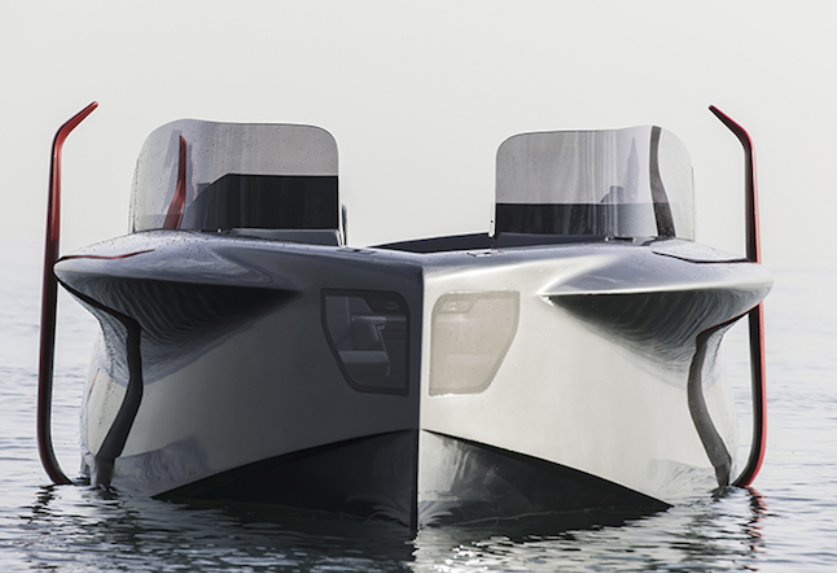
As I searched for others who may have tackled and solved the many issues that arise from getting a boat up on a foil and doing so with electric power, I came across a good example of both style and great design in the Foiler pictured below. But this boat is designed as a million dollar tender for a super yacht not the weekend getaway craft I have in mind. The brilliant development here is the shape and position of the foils. With a slightly different design but the same principal of a hinged pair of foils that could fold up around the yacht to be out of the way for docking or running on the hull, this boat would be the best of both worlds. You could even put the boat on a trailer for land transport (initial delivery) and storage.
https://images.app.goo.gl/2JoJ8V7WF2AXL4Sd6
Cavitated Foils
A key issue with hydrofoils is how the foil itself is positioned in the water. If it is fully submerged the foil likely requires stabilizing software and constant adjustment. If the foil breaks the surface of the water at an angle it becomes naturally stable because the foils on each side automatically lift and roll the boat back toward the center. When both sides do this it becomes a very stable design with no stabilizing software or adjustment required. When the boat rolls to one side that foil has more of its wing in the water producing more lift (and more drag) while the foil on the other side does the opposite producing less lift as more of it comes out of the water. This naturally rolls the boat into its center-most and stable position.
The Slowest Hydrofoil Ever Made
Like the Candella design, the Foiler (pictured) is optimized for speed not range so it uses two big gasoline-powered BMW engines for thrust and the electric motors for only a short range trip. With no solar panels, or much surface to add them, the Foiler is a fancy tender not a weekend yacht. Where water is 1,000x more dense than air, a great deal more weight can be “flown” through the water than can be in the air. However, while increasing the foils’ surface area greatly increases lift, it sacrifices speed due to greater drag. But that is okay because the design of the Model S of boats is optimized for the greatest combination of boat size with infinite range at 12 knots. As solar panels get more efficient and batteries more energy-dense, the equations just get better.

https://images.app.goo.gl/b25c9PwZUCUca1Aj8
When Elon Musk was asked about the Model S sedan and why he designed it the way he did, his response was that he wanted a stylish car with performance that would take his whole family (himself, his wife and three kids). The Model S of Boats has similar goals – to take a family out on the water for a weekend in style but without using anything other than the power of the sun, not unlike the way a sailboat does with the wind, but in this case you are not constrained by a max 6 knots under motoring or tacking along a less direct route under sail.
This boat will feature a long roof covering most of the length of the boat as well as other surfaces covered in solar panels that gather the maximum power possible from the sun. The heavy batteries are positioned near the centre of the boat to minimize their range of motion rather than hanging off a transom at the stern. A rack above the roof could be added to house radio antennae, GPS and radar not to mention potentially a vertical wind turbine to gather still more energy.
Prudence demands backup systems as any sailor would argue so a gas or diesel generator onboard would be a likely if not necessary addition. The system would be a serial hybrid where the fuel motor would not drive the boat directly rather it would generate power for the battery pack to then feed into the motors. 5run systems on the boat and to extend range. This further reduces maintenance and points of failure by eliminating the mechanical extensions to a drive system from gears and a transmission to extra drive shafts or other elements.
Slow range is the objective, not high speed. Once up on a foil the amount of energy required to keep the boat there is minimal so coming in and out of the water constantly will be one of the most taxing activities on the battery pack. As a result, maintaining a foil at a very slow cruising speed will be essential to creating the world’s slowest Hydrofoil.
Follow My Blog
Get new content delivered directly to your inbox.
 Whistlerborn's Blog